

Starting a lime plastering business UK
Starting a lime plastering business UK
Most plasterers can skim a wall. Far fewer understand how to work with lime, read damp in a solid-wall building, or produce a three-coat lime render that will last a generation. That gap between supply and demand is exactly why starting a lime plastering business in the UK is worth serious consideration in 2026.
The UK has roughly 6 million pre-1919 homes, most of them built with solid brick or stone walls and lime mortars. When these buildings are repointed or re-plastered with modern cement products, they trap moisture and deteriorate. The remediation work — stripping out cement, restoring breathability with lime — keeps lime plasterers busy for years. Add listed buildings, conservation areas, and a growing interest in sustainable building materials, and the market is genuinely solid.
This guide covers what you need to set up a lime plastering business: qualifications, tools, pricing, and the practical side of running the business.
Is there actually enough work?
Yes, in most parts of the UK. Heritage restoration is a steady, non-cyclical market. Listed building owners have no choice about the materials used — English Heritage and Historic England specify lime for conservation projects and planning permission often requires it. That removes the price comparison problem you get in standard plastering, where customers shop around for the cheapest price per square metre.

Demand is particularly strong in areas with high concentrations of older stock: the Cotswolds, the North Yorkshire Moors, Welsh market towns, Scottish stone-built properties, Victorian terraces in northern cities. If you're in or near a conservation area, there is work.
Wet rot and rising damp remediation using breathable lime plasters is also growing as builders and surveyors understand better why cement pointing fails in old buildings. Damp specialists, heritage surveyors, and conservation architects become useful referral sources once you've built relationships with them.
Qualifications for lime plastering
There is no single mandatory licence for plastering in the UK, but clients, local authorities, and conservation officers expect to see evidence of competence, especially on listed buildings.
NVQ qualifications
The standard qualification pathway for plasterers runs through CITB NVQ qualifications:
- NVQ Level 2 Diploma in Plastering (Construction) — covers solid plastering including heritage pathways. Qualifies for a CSCS Blue Card.
- NVQ Level 3 Diploma in Plastering — supervisory level. Qualifies for a CSCS Gold Card. Many listed building contractors require Level 3 for lead plasterers.
Both are available as portfolio-based assessments for experienced plasterers who didn't complete formal training initially. This is sometimes called an NVQ via portfolio or experienced worker route, and it's a practical option if you've been working in the trade for years without a formal qualification.
Heritage-specific training
For dedicated lime and heritage plastering, several specialist training providers run focused programmes:
The Carrington Lime Professional Heritage Plastering Programme is a four-month programme combining practical and theory work, with live on-site experience. It produces a Level 3 NVQ Diploma in Heritage Skills (Construction) — Plastering (Solid). Applications open in June.
The Tywi Centre in Wales offers heritage plastering training and NVQ assessment, with a particular focus on traditional Welsh stone buildings. If you're working in Wales or the Welsh Marches, this is worth looking into.
The key requirement for employer-based programmes is that your employer (or you, if self-employed) has access to heritage sites with sufficient assessment opportunities. If you're already doing lime work on old buildings, this condition is usually straightforward to meet.
CSCS card
For any work on construction sites — including refurbishment projects on larger heritage buildings — you'll need a CSCS card. The Blue Card is issued with an NVQ Level 2; the Gold Card with Level 3.
Tools and materials you'll need
Lime plastering uses different tools and techniques from gypsum work. If you're coming from conventional plastering, expect a period of adjustment. The main differences:
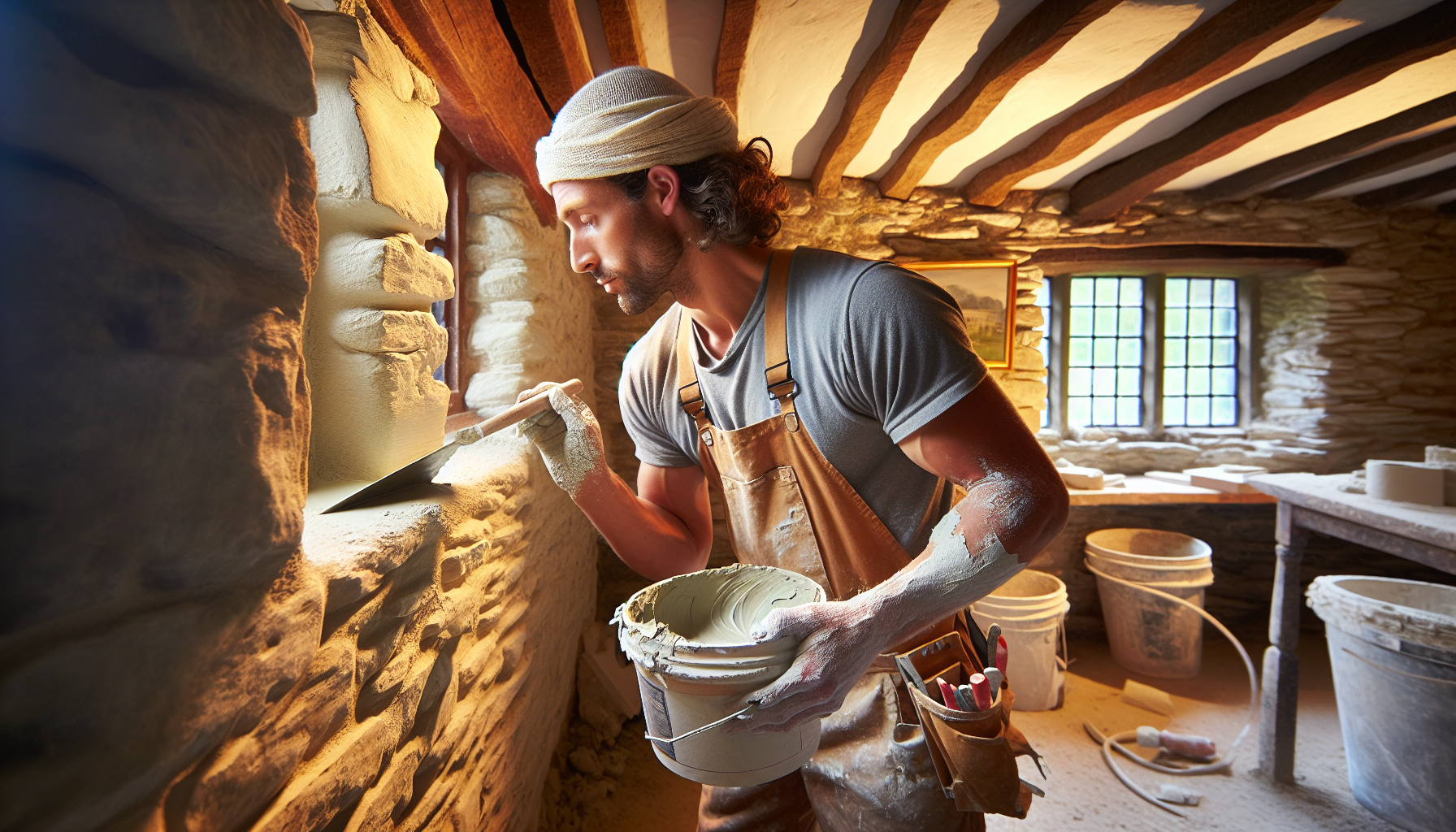
- Lime sets by carbonation, not chemical reaction — it goes off slowly, allowing longer working time and requiring different finishing approaches
- Three-coat systems are standard: scratch coat, float coat, finish coat. Each coat must be allowed to carbonate before the next is applied
- Haired lime mortars (lime with animal hair or fibres) are used for the basecoats on historic substrates
- You can't rush it. Trying to shortcut the drying time produces cracks and failures
Tools: standard plasterer's tools work, but you'll also need a hawk with a longer backing (lime mixes are heavier), a range of floats for different surface textures, a scratch comb or devil float, and a mixing paddle for a drill. Keep your tools clean — lime contamination of gypsum tools causes problems.
Materials: you'll be working with hydraulic limes (NHL 2, NHL 3.5, NHL 5) and non-hydraulic lime putty depending on the substrate and specification. Get familiar with the different products from suppliers like Lime Technology, Ty-Mawr, and St Astier. Some conservation officers specify particular product ranges, so flexibility matters.
Van and storage: lime products are heavy and some need to be kept dry. A transit-sized van and covered storage is adequate for a sole trader. Budget £25,000 to £40,000 for a decent second-hand van and basic stock.
What to charge for lime plastering
Lime plastering rates in 2026 are significantly higher than standard gypsum work, and rightly so — the skill level and time commitment are greater.
Invoice your customers in 30 seconds
InvoiceAdept helps UK tradespeople send professional invoices, track payments, and stay MTD-compliant — all from your phone.
Start for free — no card neededDay rates for specialist lime plasterers currently run from £200 to £350 per day, with London and the South East at the upper end. Heritage and listed building work commands a premium. Installed rates per square metre depend heavily on the specification:
- Standard lime plaster finish: £22 to £35 per m2
- Heritage-grade lime plaster on solid walls: £50 to £100 per m2
- Complex ornate work, cornices, or hidden damp remediation: £100 to £160+ per m2
Don't undercharge on heritage work. Clients on listed buildings understand that specialist work costs more. Charging standard rates damages your credibility and creates problems when the job takes longer than a standard plaster would.
Before quoting, always do a thorough survey. Lime work on old buildings regularly uncovers issues — previous failed repairs, hidden damp, structural movement — that aren't visible on the surface. Quote to cover a contingency, and make clear in writing what's included and what will be an additional charge.
Use a quote generator to produce clear, itemised quotes that specify the lime product specification, number of coats, and what the price excludes. On heritage work this matters even more than usual because clients need documentation for listed building consent applications.
Setting up the business
Sole trader vs limited company
Most lime plasterers start as sole traders and incorporate later if turnover warrants it. The VAT threshold is £90,000 in 2026 — if you're a specialist sole trader, you may hit this within a year or two, so factor in whether you're better off registering voluntarily from the start if your clients are VAT-registered businesses (which many heritage architects and developers are).
Insurance
You need public liability insurance — at minimum £2 million, preferably £5 million for work on listed buildings. If you're advising clients on materials or producing specifications, get professional indemnity insurance too. Some conservation architects and main contractors won't sub-contract to you without it.
Building relationships with conservation professionals
Your best source of referrals in lime plastering is conservation architects, building surveyors with heritage experience, and approved building inspectors. These professionals specify lime work in their reports and recommend contractors to clients. A single relationship with a conservation architect can sustain a sole trader's workload indefinitely.
Historic England publishes guidance documents and maintains registers of traditional building skills. Getting listed on the Historic England skills register or similar directories increases your visibility with clients and specifiers who prioritise properly qualified contractors.
Managing cash flow
Heritage projects often involve staged payments, with clients paying on completion of each coat or phase. On a three-coat system with drying time between coats, a job can span three or four weeks with payments spread across the period. Keep your invoicing up to date and don't let payments slide.
Use an invoice generator to issue invoices promptly at each stage and track what's outstanding. On listed buildings particularly, clients sometimes try to hold final payments pending sign-off from conservation officers, which can be slow. Having a clear paper trail from quote to invoice to payment makes chasing much simpler.
Frequently asked questions
Do I need a qualification to do lime plastering commercially?
There is no legal licence required specifically for plastering in the UK. However, for listed buildings and conservation work, clients and conservation officers expect evidence of competence. An NVQ Level 2 or 3 with a heritage pathway, or completion of a specialist heritage plastering programme, is the standard way to demonstrate this.

How is lime plastering different from standard gypsum plastering?
Lime sets slowly by absorbing carbon dioxide from the air rather than through a chemical reaction like gypsum. This means longer working time but also longer drying time between coats. Three-coat systems are standard. You also work with different materials — hydraulic lime mixes and lime putty rather than pre-mixed gypsum products. The techniques for achieving different textures and finishes differ significantly.
Can I learn lime plastering through short courses rather than an NVQ?
Yes. Several specialist suppliers and training centres run one to three day introduction courses on lime plastering techniques. These are useful for gaining practical skills but don't produce a formal qualification. For commercial work on heritage buildings, particularly listed properties, a formal NVQ or heritage qualification carries more weight with clients and conservation officers.
Is there enough work in my area?
This depends on your location. Areas with high concentrations of pre-1919 solid-wall buildings — particularly conservation areas and settlements with listed buildings — have strong demand. If you're unsure, spend a few hours on Checkatrade, TrustATrader, or local Facebook groups looking at what's being requested in your area. Conservation architects and heritage surveyors are also good people to speak to about local demand.
What day rate should I be charging as a lime plastering specialist?
In 2026, specialist lime plasterers are charging £200 to £350 per day depending on location and the complexity of the work. Heritage and listed building rates are at the upper end of this range. Don't price yourself at standard plastering rates — specialist lime work takes longer and requires more skill, and clients on heritage projects understand and expect to pay a premium.
Ready to get started?
InvoiceAdept helps UK tradespeople send invoices, track payments, and stay compliant — all from one place.
Start for freeNo credit card required